14.10.2024
6 mins
When a farm pond leaks, a landfill cell fails, or a water reservoir loses containment, the consequences extend well beyond the immediate site. Environmental liability, regulatory scrutiny, and the cost of remediation make liner selection one of the most consequential decisions in any containment project. High-density polyethylene geomembrane — universally referred to as HDPE — has become the material of choice across New Zealand and internationally, and for good reason.
What Is HDPE Geomembrane?
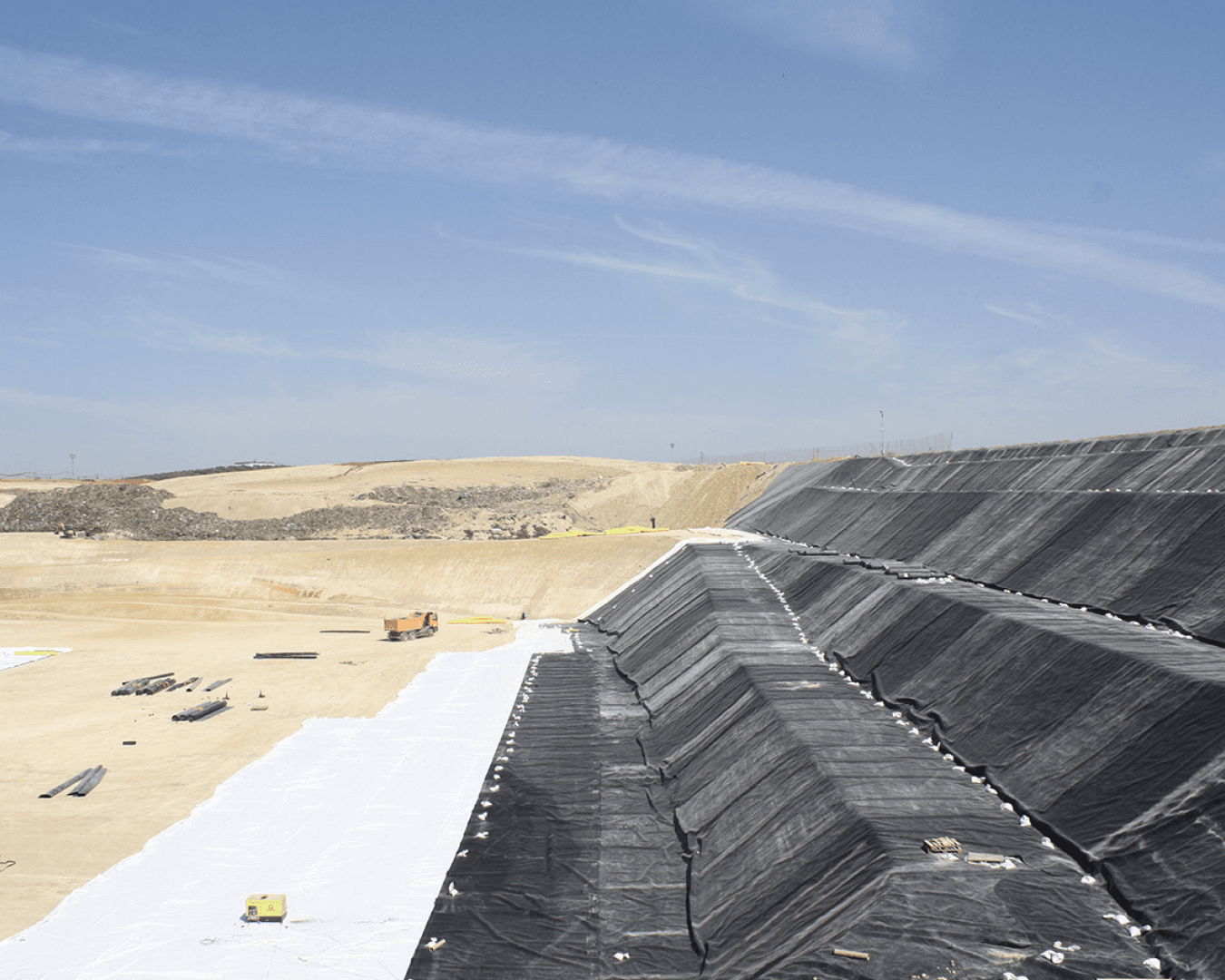
HDPE geomembrane is a synthetic, flexible liner manufactured from high-density polyethylene resin. It is engineered specifically to act as an impermeable barrier, preventing the movement of liquids or gases between a contained area and the surrounding environment. The material is produced in large factory rolls and installed on-site, where individual sheets are thermally welded together to form a continuous, seamless membrane.
Standard thicknesses range from 0.75 mm for light-duty applications up to 2.5 mm or more for demanding environments such as landfills and industrial containment ponds. In New Zealand, 1.0 mm and 1.5 mm smooth HDPE is the most commonly specified thickness for general-purpose pond lining, water storage, and vapour barrier applications.
Why HDPE?
The dominance of HDPE in the geomembrane market reflects a genuinely superior combination of physical and chemical properties.
Chemical resistance is perhaps the most important characteristic. HDPE resists attack from the vast majority of acids, alkalis, hydrocarbons, and industrial effluents encountered in real-world containment applications. This makes it suitable for everything from agricultural effluent ponds to leachate containment in landfills and industrial chemical storage.
Impermeability is exceptional. HDPE geomembrane has a permeability coefficient in the order of 10⁻¹³ cm/s, making it effectively impermeable to both liquids and gases when correctly installed and welded.
Longevity is well-established. When buried or otherwise protected from direct UV exposure, the theoretical service life of HDPE geomembrane exceeds 100 years. Even in exposed applications such as open reservoirs or capping layers, service lives of 20 to 50 years are achievable depending on UV load and installation conditions.
UV and weathering resistance is supported by the incorporation of carbon black — typically 2–3% by mass — into the resin during manufacture. Carbon black is highly effective at absorbing and dissipating UV radiation, which is why HDPE geomembrane retains its mechanical properties in exposed outdoor applications where other polymers would degrade more rapidly.
Mechanical strength is substantial. A standard 1.5 mm HDPE geomembrane delivers tensile strength in the range of 25–40 kN/m and elongation at break exceeding 700%, giving the installed liner considerable capacity to accommodate minor ground movement or settlement without failure.
Where Is HDPE Geomembrane Used?
The range of applications is broad. In New Zealand, HDPE geomembrane is routinely specified for effluent storage and treatment ponds on farms and at wastewater treatment plants, potable water reservoirs and irrigation storage, landfill liner and capping systems, sub-slab gas and vapour barriers on contaminated or brownfield sites, underground stormwater retention and detention tanks, floating solar pontoon foundations, and chemical containment bunds and secondary containment systems.
The common thread across all of these applications is the need for a reliable, durable barrier — one that will perform without maintenance for the life of the asset it protects.
Installation Quality Matters
HDPE geomembrane is only as good as its installation. The material itself can be manufactured to consistent, verified specifications, but the performance of the installed liner depends heavily on the quality of on-site welding and the competence of the installation crew.
Field seams are created using two principal methods: fusion welding, where a dual-track hot wedge machine creates two parallel bond tracks separated by an air channel that can be pressure-tested; and extrusion welding, where a bead of molten HDPE rod is extruded over the overlapping liner edges. Both methods, when correctly executed by trained and experienced personnel, produce seams that are as strong as — or stronger than — the parent material.
GR Environmental Lining Ltd has installed over five million square metres of HDPE geomembrane across New Zealand since the company was founded in the 1990s. Every welded seam is non-destructively tested before a project is signed off.
Specification and Standards
HDPE geomembrane is manufactured and tested to internationally recognised standards. GRI GM13 (Geosynthetic Research Institute, USA) is the most widely referenced specification for smooth HDPE geomembrane, covering physical properties including thickness, density, tensile strength, tear resistance, puncture resistance, stress crack resistance, and carbon black content. Reputable manufacturers provide test certificates verifying compliance with these standards for each production batch.
For projects in New Zealand requiring a formal Design and Build basis, NZS 3916 informs the design of geomembrane containment systems where relevant.