17.08.2025
5 mins
A geomembrane liner is only as good as its weakest seam. The HDPE panels that make up an installed liner system are typically 5 to 8 metres wide and arrive on site in rolls. They are overlapped and welded together in the field to form a continuous membrane, and it is at those welds — running for hundreds or thousands of metres on a large installation — that the risk of failure is concentrated.
GR Environmental Lining Ltd tests 100% of installed weld length on every project. This post explains the two primary non-destructive test methods used, and why the distinction between fusion welding and extrusion welding matters when it comes to testing.
Two Welding Methods, Two Test Methods
Fusion welding (hot wedge welding) is used for long, straight seams — the primary field seams that join adjacent panels of liner across the main body of a pond, reservoir, or slab. An automated wedge welding machine is guided along the overlap between two panels. A heated wedge is inserted between the liner sheets, melting both surfaces simultaneously, and the molten surfaces are immediately pressed together by drive rollers. The result is a dual-track weld: two parallel bond tracks with a non-bonded air channel between them.
Extrusion welding is used for detail work — patches, repairs, penetrations, corners, and areas where the geometry or access does not suit an automated machine. A hand-held extrusion welder feeds HDPE rod through a heated barrel, extruding a continuous bead of molten material over the overlapping liner edges to form a single-track fillet weld.
Testing Fusion Welds: Air Pressure Testing
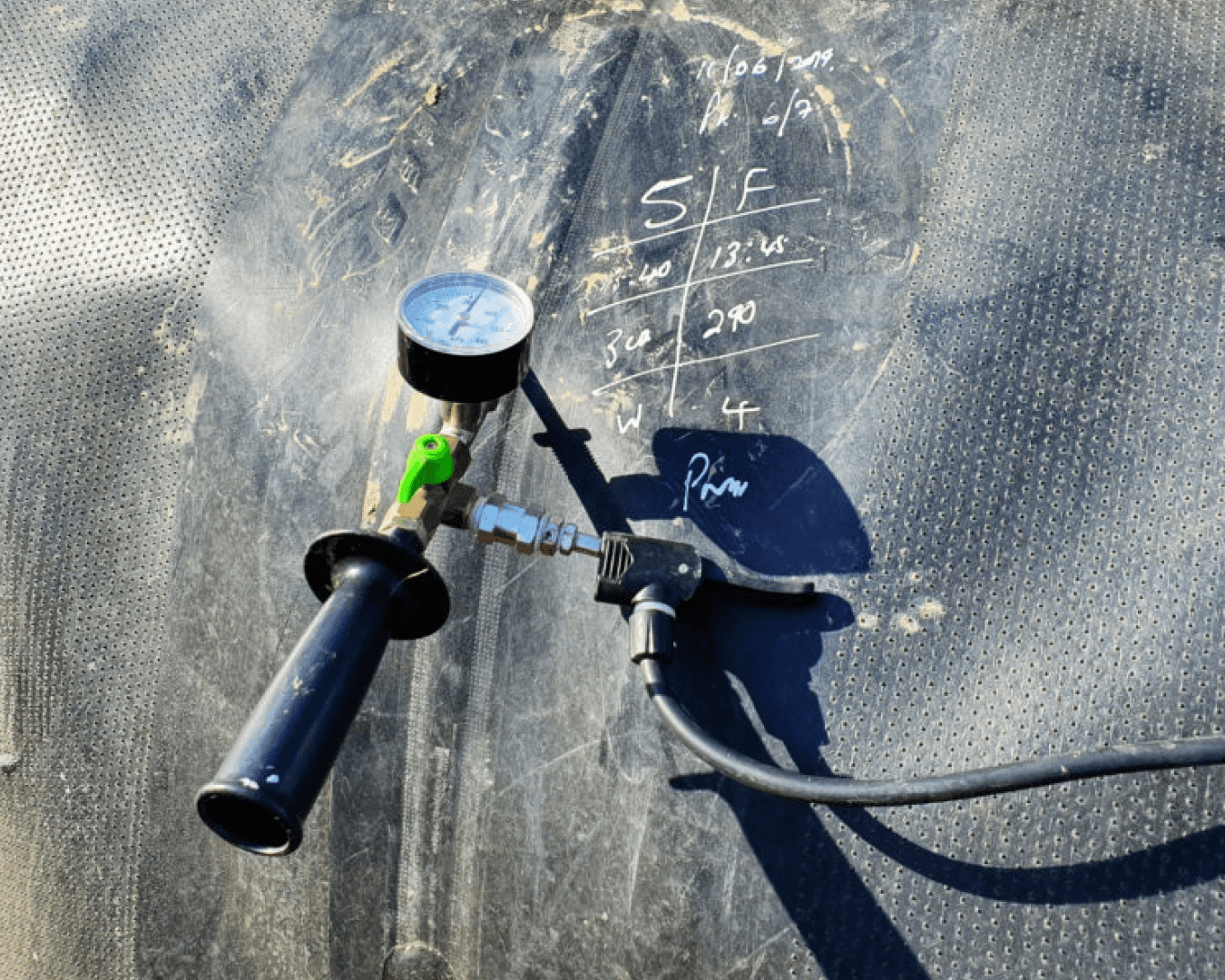
The air channel in a dual-track fusion weld is a built-in quality assurance feature. Once a section of weld has cooled, a needle is inserted into the sealed air channel at one end, and the channel is inflated to a test pressure using compressed air. The channel is then sealed at both ends and monitored for pressure drop over a set time period.
A weld that is continuous and correctly formed will hold pressure. Any discontinuity — a hole, an unbonded section, a void in the weld — will allow air to escape, and the pressure gauge will show a drop. This test provides 100% coverage of the installed fusion weld length. Every metre of primary seam on a project is tested before the installation is accepted.
Testing Extrusion Welds: Spark Testing
Extrusion welds produce a single-track fillet, not a dual-track weld with an air channel, so air pressure testing is not applicable. Instead, extrusion welds are tested using a high-voltage spark tester (also known as a holiday detector).
The method relies on an electrically conductive wire embedded in the liner beneath the extrusion weld before the bead is laid. The wire runs along the full length of the weld. Once the weld has set, the spark tester is passed along its length. If the weld is continuous and intact, the insulating HDPE prevents an arc forming. If there is a void, pinhole, or disbonded area, the probe arcs through the gap to the embedded wire, producing a visible and audible spark that immediately identifies the defect location. The defect is marked, repaired, and re-tested.
Why 100% Testing Matters
Statistical sampling — testing a percentage of weld length and extrapolating — is not adequate for containment applications where the consequences of a leak are environmental contamination, regulatory non-compliance, or loss of an irreplaceable resource such as stored water. A single undetected weld defect can render the entire liner system ineffective.
100% non-destructive testing creates a documented quality record: seam identification, test pressures, pass/fail results, and any repairs carried out. This record forms part of the project's as-built documentation and provides the asset owner with evidence that the installation was completed to a verified standard.
For clients commissioning a geomembrane installation for the first time, the most important question to ask any contractor is simple: how do you test your welds, and what documentation do you provide?
Summary
Fusion-welded seams are tested by air pressure testing the dual-track air channel — every metre, every project. Extrusion-welded seams are tested by spark testing against an embedded conductive wire — again, 100% of the weld length. Together, these two methods provide complete, documented verification of weld integrity across an installed liner system, regardless of project size or application type.